
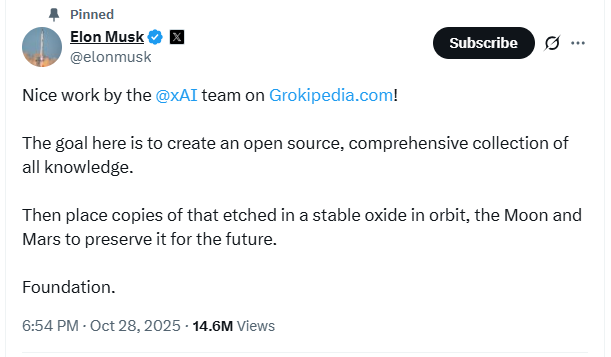
Mask announced in social media that his online encyclopaedia of the Bibuki encyclopaedia Grokipedia is now officially online. Mask has repeatedly criticized Wikipedia for its “advertising content” and has called on the public to stop contributing to a website run by a non-profit organization. In September this year, he announced the development of Grokipedia.
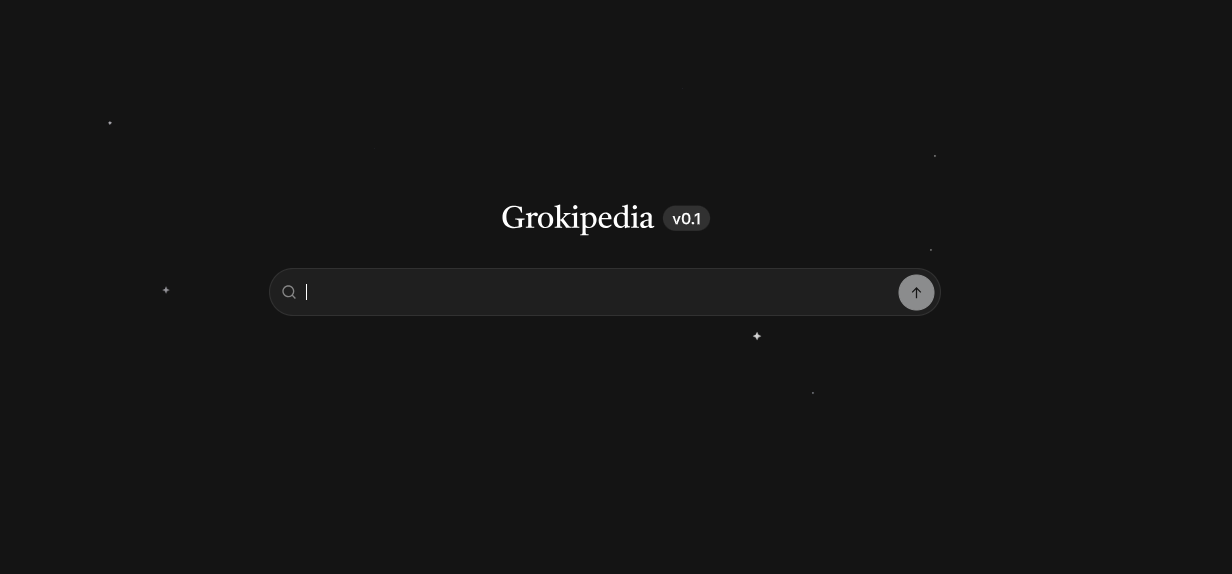
The current interface in Grokipedia is extremely brief and only a search box is available for query. The site claims to have 88,5279 entries, while Wikipedia has surpassed 7 million entries in English. Wikipedia relies on volunteers to prepare the revisions, while the mechanism for project creation in Grokipedia is currently unclear. It has been reported that the platform is driven by the same xAI model as the Grok chat robot, but some entries appear to be directly adapted from Wikipedia.
The Wiki Media Foundation in San Francisco released a statement on Tuesday that “the working mechanisms of Grokipedia are still being understood”. As a result of structural evolution and the use of a very limited mass of text resources, Wikipedia has become a key resource in the training of AI models such as Grok competitors ChatGPT and Google Gemini. “Assisting on the knowledge created by these humans to generate content, even Grokipedia needs Wikipedia to exist.” Wikimedia Foundation emphasizes. In recent months, Wikipedia has continued to be the target of attacks by right-wing United States politicians. In August, United States Republican parliamentarians launched an investigation into what they call “manipulation” in their editing process, alleging that this could inject prejudice and undermine the neutrality of the platform and the AI system that relies on its data. According to the Associated Press, Wikipedia requires volunteer editors to provide original sources for almost every sentence or paragraph and unverified statements may be challenged and removed. Some of the entries in Grokipedia, such as the one on the Juro dynasty of the ancient Indian state, provide only three links, while the Wikipedia equivalents contain 113 links and dozens of reference books.
Grokipedia accused the platform of “systematic ideological bias — in particular, a left-wing bias in reporting on politicians and issues”. The Wikimedia Foundation responded that “unlike the emerging projects, the advantages of Wikipedia are obvious: it has transparent policies, strict volunteer oversight mechanisms and a strong culture of continuous improvement. As an encyclopaedia, Wikipedia aims to provide information to billions of users, not a declaration of specific positions.”